Antibacterial Activity of Dishwashing Detergents against Foodborne Pathogens: A Laboratory-Based Evaluation
DOI:
https://doi.org/10.31580/acwt5254Keywords:
Antibacterial activity, Escherichia coli, Household detergents, Kitchen sponge, Minimum inhibitory concentration, Salmonella typhi, Staphylococcus aureusAbstract
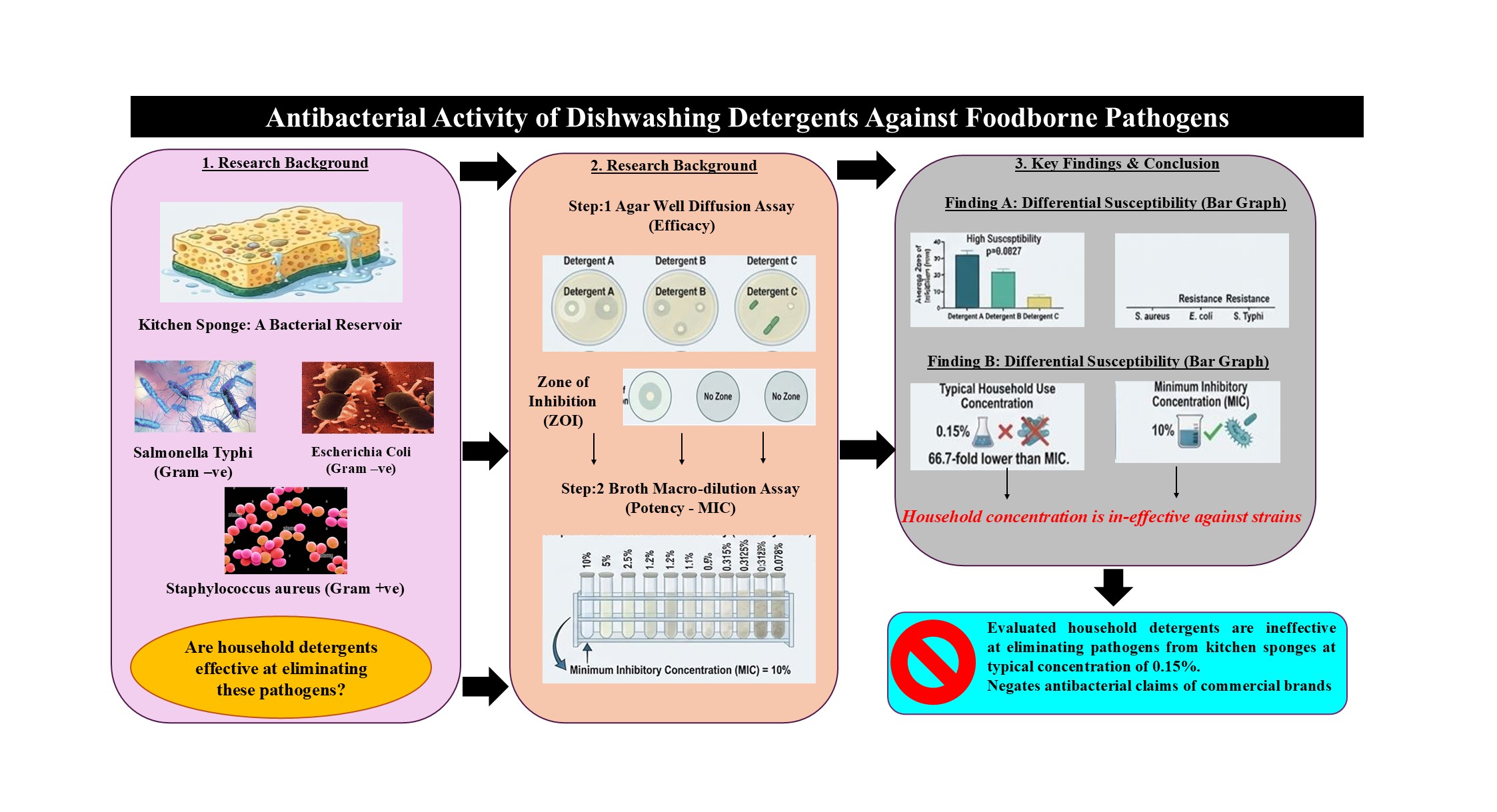
Kitchen sponges are essential cleaning tools used in almost every household; however, their porous structure and moisture-retaining ability make them an ideal environment for bacterial growth. This study aimed to evaluate the antibacterial efficacy of three commonly used household dishwashing detergents against Escherichia coli ATCC 8739, Salmonella Typhi ATCC 19430, and Staphylococcus ATCC 25923. The antibacterial activity was determined using the well diffusion method, while the Minimum Inhibitory Concentration (MIC) was evaluated using the broth macro-dilution technique. The results demonstrated that all tested detergents showed antibacterial activity against Staphylococcus aureus (zones of inhibition up to 38.0 mm) but failed to inhibit the growth of Escherichia coli and Salmonella Typhi under the tested conditions. MIC analysis revealed that a detergent concentration of 10% was required to inhibit bacterial growth, which is approximately 66 times higher than the typical household concentration (0.15%). Agar well assay validates the effects of all three detergents against only one bacterial species under observation, S. aureus (38.0 ± 10.58 mm) but there was no significant activity against S. typhi or E.coli. Surprisingly, Minimum Inhibitory Concentration (MIC) testing revealed that inhibiting bacterial growth required a detergent concentration of at least 10%, which far exceeds the standard household dilution of 0.15%. This discrepancy proved statistically significant () across both gram-positive and gram-negative bacteria, demonstrating that everyday dishwashing detergents fall short of effectively clearing pathogens from kitchen sponges. These findings further negate the antibacterial claims of commercially available detergents and suggest a strong need for subsequent disinfection methods such as increasing the concentration of active ingredients and to regularly replace the sponges (2-4 days).
Downloads
Published
Issue
Section
License
Copyright (c) 2026 Pak-Euro Journal of Medical and Life Sciences

This work is licensed under a Creative Commons Attribution 4.0 International License.