Genetic Landscape of Obesity: Interplay Between Genetics, Environment and Lifestyle - A Review
DOI:
https://doi.org/10.31580/pjmls.v8iSp3.3477Keywords:
BMI, Gut microbiome, GWAS, Melanocortin 4 receptor gene, NGSAbstract
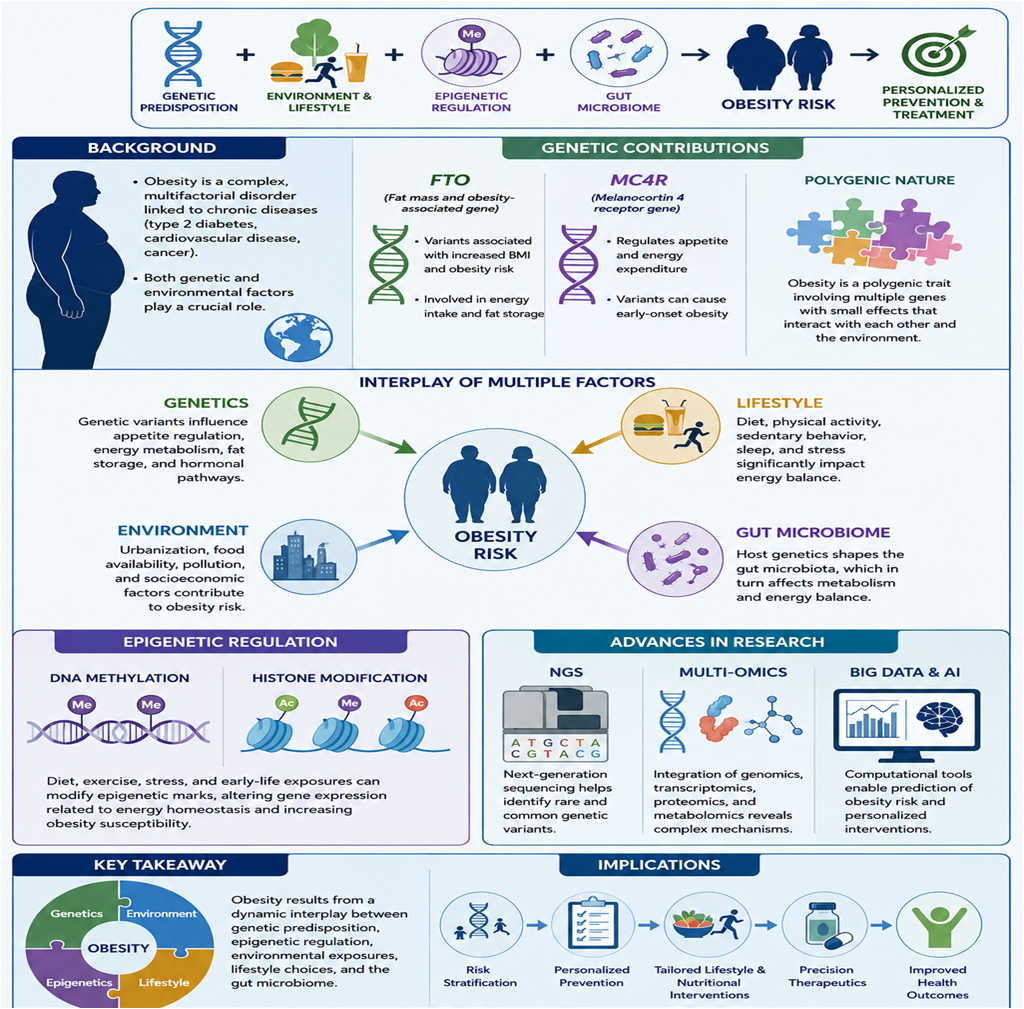
Obesity is a complex and multifactorial disorder with both environmental and genetic factors. Although such as diet and physical activity are important lifestyle factors in the etiology of obesity, there is growing evidence that hereditary predisposition is a major cause for the susceptibility to excess weight gain. Genome-wide association studies (GWAS) have implicated numerous genetic variants that are linked to obesity, including those that are involved in fat storage, energy metabolism, and appetite regulation. Of these, variants of genes such as FTO (fat mass and obesity-associated gene) and MC4R (melanocortin 4 receptor gene) have been strongly associated with elevated body mass index (BMI) and obesity risk. In addition to single-gene effects, obesity is a polygenic disorder, where multiple genes interact with each other and with environmental determinants to determine obesity outcomes. DNA methylation and histone modification are Epigenetic marks that can also modulate gene expression in response to diet, exercise, and early life exposures. It affect obesity risk. Recent technological advances in next-generation sequencing (NGS) and multi-omics have also provided more insight into how genetic and epigenetic obesity determinants function. Most importantly, the gut microbiome has also emerged as an important determinant, with studies indicating that host genetics can modulate the composition of the microbiota, which in turn affects metabolism and energy balance. Current evidences of genomic and genetic studies shows that obesity is affected by several genes involved in appetite regulation, energy metabolism, hormonal control and environmental factors. These discoveries demonstrate the genetic, lifestyle and epigenetic factors involved in obesity and it also explain the concept of personalized patient care.
References
1. Ang, M.Y., F. Takeuchi, and N. Kato, Deciphering the genetic landscape of obesity: a data-driven approach to identifying plausible causal genes and therapeutic targets. Journal of Human Genetics, 2023. 68(12): p. 823-833.
2. Semenova, E., et al., The expanding landscape of genetic causes of obesity. Pediatric Research, 2024: p. 1-12.
3. Yang, J., Expanding the genetic landscape of obesity. Cell Genomics, 2023. 3(9).
4. Young, K.L., et al., Genetics of obesity in diverse populations. Current diabetes reports, 2018. 18: p. 1-10.
5. Waalen, J., The genetics of human obesity. Translational Research, 2014. 164(4): p. 293-301.
6. Vadadokhau, U., et al., Examination of the Complex Molecular Landscape in Obesity and Type 2 Diabetes. International Journal of Molecular Sciences, 2024. 25(9): p. 4781.
7. Herrera, B.M. and C.M. Lindgren, The genetics of obesity. Current diabetes reports, 2010. 10: p. 498-505.
8. O'Rahilly, S. and I.S. Farooqi, Genetics of obesity. Philosophical Transactions of the Royal Society B: Biological Sciences, 2006. 361(1471): p. 1095-1105.
9. Loos, R.J. and G.S. Yeo, The genetics of obesity: from discovery to biology. Nature Reviews Genetics, 2022. 23(2): p. 120-133.
10. Farooqi, I.S. and S. O’Rahilly, Genetics of obesity in humans. Endocrine reviews, 2006. 27(7): p. 710-718.
11. Clement, K., P. Boutin, and P. Froguel, Genetics of obesity. American Journal of Pharmacogenomics, 2002. 2: p. 177-187.
12. Bouchard, C., Genetics of obesity: what we have learned over decades of research. Obesity, 2021. 29(5): p. 802-820.
13. Farooqi, I.S. and S. O'Rahilly, Monogenic obesity in humans. Annu. Rev. Med., 2005. 56(1): p. 443-458.
14. Pigeyre, M. and D. Meyre, Monogenic obesity. Pediatric obesity: etiology, pathogenesis and treatment, 2018: p. 135-152.
15. O’Rahilly, S., et al., Minireview: human obesity—lessons from monogenic disorders. Endocrinology, 2003. 144(9): p. 3757-3764.
16. Farooqi, I. and S. O Rahilly, Monogenic human obesity syndromes. Recent progress in hormone research, 2004. 59: p. 409-424.
17. Huvenne, H. and B. Dubern, Monogenic forms of obesity, in Molecular mechanisms underpinning the development of obesity. 2014, Springer. p. 9-21.
18. Hinney, A. and J. Hebebrand, Polygenic obesity in humans. Obesity facts, 2008. 1(1): p. 35-42.
19. Hinney, A., C.I. Vogel, and J. Hebebrand, From monogenic to polygenic obesity: recent advances. European child & adolescent psychiatry, 2010. 19: p. 297-310.
20. Hinney, A. and J. Giuranna, Polygenic obesity. Pediatric Obesity: Etiology, Pathogenesis and Treatment, 2018: p. 183-202.
21. Khera, A.V., et al., Polygenic prediction of weight and obesity trajectories from birth to adulthood. Cell, 2019. 177(3): p. 587-596. e9.
22. Abadi, A., et al., Penetrance of polygenic obesity susceptibility loci across the body mass index distribution. The American Journal of Human Genetics, 2017. 101(6): p. 925-938.
23. Golden, A. and C. Kessler, Obesity and genetics. Journal of the American Association of Nurse Practitioners, 2020. 32(7): p. 493-496.
24. Jansen, P.R., et al., The utility of obesity polygenic risk scores from research to clinical practice: A review. Obesity Reviews, 2024. 25(11): p. e13810.
25. Belsky, D.W., et al., Polygenic risk, rapid childhood growth, and the development of obesity: evidence from a 4-decade longitudinal study. Archives of pediatrics & adolescent medicine, 2012. 166(6): p. 515-521.
26. Hetherington, M.M. and J.E. Cecil, Gene-environment interactions in obesity. Frontiers in Eating and Weight Regulation, 2010. 63: p. 195-203.
27. Huang, T. and F.B. Hu, Gene-environment interactions and obesity: recent developments and future directions. BMC medical genomics, 2015. 8(Suppl 1): p. S2.
28. Qi, L. and Y.A. Cho, Gene-environment interaction and obesity. Nutrition reviews, 2008. 66(12): p. 684-694.
29. Andreasen, C.H. and G. Andersen, Gene–environment interactions and obesity—Further aspects of genomewide association studies. Nutrition, 2009. 25(10): p. 998-1003.
30. Ahmad, S., T.V. Varga, and P.W. Franks, Gene× environment interactions in obesity: the state of the evidence. Human heredity, 2013. 75(2-4): p. 106-115.
31. Sulc, J., et al., Quantification of the overall contribution of gene-environment interaction for obesity-related traits. Nature communications, 2020. 11(1): p. 1385.
32. Tessier, F., et al., Investigating Gene–Gene and Gene–Environment Interactions in the Association Between Overnutrition and Obesity-Related Phenotypes. Frontiers in genetics, 2019. 10: p. 151.
33. Gong, W., et al., Effects of gene-environment interaction on obesity among chinese adults born in the early 1960s. Genes, 2021. 12(2): p. 270.
34. Romao, I. and J. Roth, Genetic and environmental interactions in obesity and type 2 diabetes. Journal of the American Dietetic Association, 2008. 108(4): p. S24-S28.
35. Bornstein, S., et al., Approaching the shared biology of obesity and depression: the stress axis as the locus of gene–environment interactions. Molecular psychiatry, 2006. 11(10): p. 892-902.
36. Albuquerque, D., et al., The contribution of genetics and environment to obesity. British medical bulletin, 2017. 123(1): p. 159-173.
37. Speakman, J.R., Obesity: the integrated roles of environment and genetics. The Journal of nutrition, 2004. 134(8): p. 2090S-2105S.
38. van Vliet-Ostaptchouk, J.V., H. Snieder, and V. Lagou, Gene–lifestyle interactions in obesity. Current nutrition reports, 2012. 1: p. 184-196.
39. Pérusse, L. and C. Bouchard, Gene-diet interactions in obesity. The American journal of clinical nutrition, 2000. 72(5): p. 1285s-1290s.
40. Velez Edwards, D.R., et al., Gene-environment interactions and obesity traits among postmenopausal African-American and Hispanic women in the Women’s Health Initiative SHARe Study. Human genetics, 2013. 132: p. 323-336.
41. Faith, M.S. and T.V. Kral, Social environmental and genetic influences on obesity and obesity-promoting behaviors: fostering research integration, in Genes, behavior, and the social environment: Moving beyond the nature/nurture debate. 2006, National Academies Press (US).
42. Bašić, M., et al., Obesity: genome and environment interactions. Archives of Industrial Hygiene and Toxicology, 2012. 63(3): p. 395-405.
43. Cornicelli, J.A., Gene–Environment Interactions in Obesity. 2015.
44. Solovieva, S., et al., COL9A3 gene polymorphism and obesity in intervertebral disc degeneration of the lumbar spine: evidence of gene-environment interaction. Spine, 2002. 27(23): p. 2691-2696.
45. Usset, J.L., et al., Assessment of Multifactor Gene–Environment Interactions and Ovarian Cancer Risk: Candidate Genes, Obesity, and Hormone-Related Risk Factors. Cancer Epidemiology, Biomarkers & Prevention, 2016. 25(5): p. 780-790.
46. Chiu, S., et al., Gene–gene epistasis and gene–environment interactions influence diabetes and obesity. Nutritional genomics: discovering the path to personalized nutrition, 2006: p. 135-151.
47. Tyrrell, J., et al., Gene–obesogenic environment interactions in the UK Biobank study. International journal of epidemiology, 2017. 46(2): p. 559-575.
48. Wei, B.-L., et al., The MC4R SNPs, their haplotypes and gene-environment interactions on the risk of obesity. Molecular Medicine, 2020. 26: p. 1-10.
49. Blakemore, A.I. and J.L. Buxton, Obesity, genetic risk, and environment. 2014, British Medical Journal Publishing Group.
50. Greenway, F.L. and S.R. Smith, The future of obesity research. Nutrition, 2000. 16(10): p. 976-982.
51. Gortmaker, S.L., et al., Changing the future of obesity: science, policy, and action. The Lancet, 2011. 378(9793): p. 838-847.
52. Ross, R. and A.J. Bradshaw, The future of obesity reduction: beyond weight loss. Nature Reviews Endocrinology, 2009. 5(6): p. 319-325.
53. Hill, J.O. and F.L. Trowbridge, Childhood obesity: future directions and research priorities. Pediatrics, 1998. 101(3): p. 570-574.
54. Yanovski, J.A. and S.Z. Yanovski, Recent advances in basic obesity research. Jama, 1999. 282(16): p. 1504-1506.
55. Wilkie, A., Prototyping as event: designing the future of obesity, in Prototyping Cultures. 2018, Routledge. p. 95-111.
56. Pratt, C.A., J. Stevens, and S. Daniels, Childhood obesity prevention and treatment: recommendations for future research. American journal of preventive medicine, 2008. 35(3): p. 249-252.
57. Sarwer, D.B., et al., Pregnancy and obesity: a review and agenda for future research. Journal of Women's Health, 2006. 15(6): p. 720-733.
58. Finkelstein, E.A., et al., Obesity and severe obesity forecasts through 2030. American journal of preventive medicine, 2012. 42(6): p. 563-570.
59. Wilding, J., Science, medicine, and the future: obesity treatment. BMJ, 1997. 315(7114): p. 997-1000.
60. Ruhm, C.J. Current and future prevalence of obesity and severe obesity in the United States. in Forum for Health Economics & Policy. 2007. De Gruyter.
61. Carnell, S., et al., Neuroimaging and obesity: current knowledge and future directions. Obesity Reviews, 2012. 13(1): p. 43-56.
62. Scheen, A.J., The future of obesity: new drugs versus lifestyle interventions. Expert opinion on investigational drugs, 2008. 17(3): p. 263-267.
63. Rutter, H., Where next for obesity? The Lancet, 2011. 378(9793): p. 746-747.
64. Rodgers, R.J., M.H. Tschöp, and J.P. Wilding, Anti-obesity drugs: past, present and future. Disease models & mechanisms, 2012. 5(5): p. 621-626.
65. Hammond, R.A. and R. Levine, The economic impact of obesity in the United States. Diabetes, metabolic syndrome and obesity: targets and therapy, 2010: p. 285-295.
66. Choquet, H. and D. Meyre, Molecular basis of obesity: current status and future prospects. Current genomics, 2011. 12(3): p. 154-168.
67. Janssen, F., A. Bardoutsos, and N. Vidra, Obesity prevalence in the long-term future in 18 European countries and in the USA. Obesity facts, 2020. 13(5): p. 514-527.
68. Zhang, Q., et al., Integrative analysis of multi-omics data to detect the underlying molecular mechanisms for obesity in vivo in humans. Human Genomics, 2022. 16(1): p. 15.
69. Dao, M.C., et al., A data integration multi-omics approach to study calorie restriction-induced changes in insulin sensitivity. Frontiers in physiology, 2019. 9: p. 1958.
70. Badoud, F., et al., Multi-omics integrative investigation of fatty acid metabolism in obese and lean subcutaneous tissue. Omics: a journal of integrative biology, 2017. 21(7): p. 371-379.
71. Herráiz-Gil, S., et al., Multi-omic data integration in food science and analysis. Current Opinion in Food Science, 2023. 52: p. 101049.
72. Torres-Martos, Á., et al. Human multi-omics data pre-processing for predictive purposes using machine learning: a case study in childhood obesity. in International Work-Conference on Bioinformatics and Biomedical Engineering. 2022. Springer.
73. Tang, J., et al., Identifying BMI-associated genes via a genome-wide multi-omics integrative approach using summary data. Human Molecular Genetics, 2024. 33(8): p. 733-738.
74. Shahrajabian, M.H. and W. Sun, Survey on multi-omics, and multi-omics data analysis, integration and application. Current Pharmaceutical Analysis, 2023. 19(4): p. 267-281.
75. Liu, J., et al., Uncovering the gene regulatory network of type 2 diabetes through multi-omic data integration. Journal of Translational Medicine, 2022. 20(1): p. 604.
76. Roy, D., et al., Decoding visceral adipose tissue molecular signatures in obesity and insulin resistance: a multi‐omics approach. Obesity, 2024. 32(11): p. 2149-2160.
77. Anguita Ruiz, A.M., Multi-omics integration and machine learning for the identification of molecular markers of insulin resistance in prepubertal and pubertal children with obesity. 2021.
78. Torres-Martos, Á., et al., Omics data preprocessing for machine learning: A case study in childhood obesity. Genes, 2023. 14(2): p. 248.
79. Lin, B., Y. Ma, and S. Wu, Multi-omics and artificial intelligence-guided data integration in chronic liver disease: prospects and challenges for precision medicine. OMICS: A Journal of Integrative Biology, 2022. 26(8): p. 415-421.
80. Fatima, S., Transforming Healthcare with AI and Machine Learning: Revolutionizing Patient Care Through Advanced Analytics. International Journal of Education and Science Research Review, 2024. 11.
81. Ghanem, M., A.K. Ghaith, and M. Bydon, Artificial intelligence and personalized medicine: transforming patient care, in The New Era of Precision Medicine. 2024, Elsevier. p. 131-142.
82. Prusty, P.K., Personalized Medicine in Diabetes Mellitus: A Paradigm Shift for Improved Patient Outcomes.
83. Tailor, K., The patient revolution: How Big Data and analytics are transforming the health care experience. 2015: John Wiley & Sons.
84. Parmar, M.Y., et al., Revolutionizing Personalized Healthcare: The Diverse Applications of Artificial Intelligence in Medicine, in AI Innovations in Drug Delivery and Pharmaceutical Sciences; Advancing Therapy through Technology. 2024, Bentham Science Publishers. p. 109-132.
85. Nashwan, A.J., M.A. Hassan, and M.M. AlBarakat, Rethinking BMI and Obesity Management: The Transformative Role of Artificial Intelligence. Cureus, 2024. 16(2).
86. Singh, S., et al., Unveiling the future of metabolic medicine: omics technologies driving personalized solutions for precision treatment of metabolic disorders. Biochemical and Biophysical Research Communications, 2023.
87. Voss, A., Health in the Digital Age: The Rise of Personalized Medicine. 2024: eBookIt. com.
88. Sugandh, F., et al., Advances in the management of diabetes mellitus: a focus on personalized medicine. Cureus, 2023. 15(8).
89. Aminabee, S., The future of healthcare and patient-centric care: Digital innovations, trends, and predictions, in Emerging Technologies for Health Literacy and Medical Practice. 2024, IGI Global. p. 240-262.
Downloads
Published
Issue
Section
License
Copyright (c) 2026 Pak-Euro Journal of Medical and Life Sciences

This work is licensed under a Creative Commons Attribution 4.0 International License.