Investigating Anticancer Potential of Red Algae (Rhodophyceae) from Gwadar Sea Shore Research Article
Article Sidebar
Main Article Content
Abstract
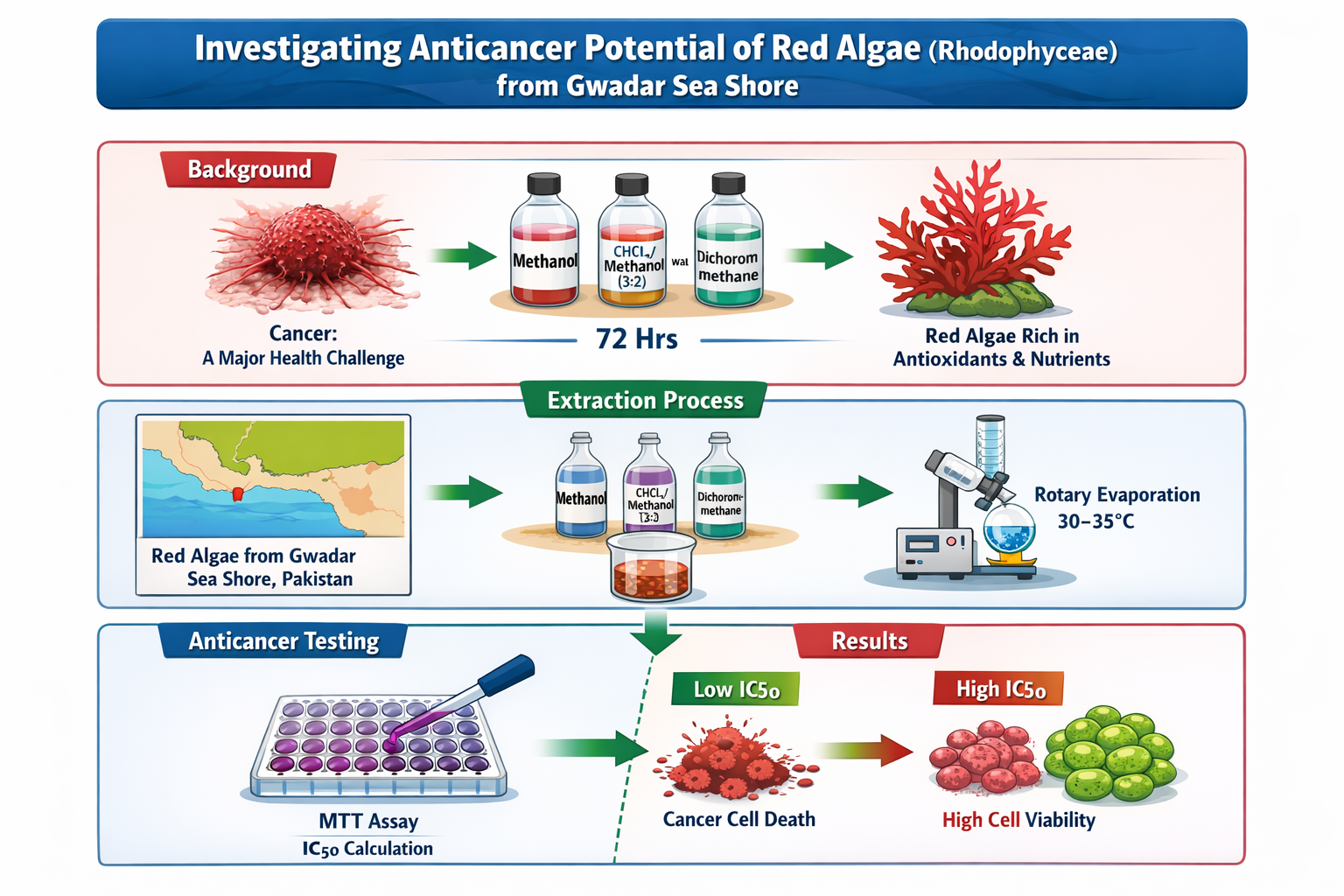
Cancer is one of the most dangerous diseases in the world due to its poor prognosis, negative treatment outcomes, and medication resistance. Nowadays, many chemical therapies and harsh techniques are used to cure cancer, which can affect the body's other healthy cells. For this reason, red algae are a potential treatment option. The red algae have a low calorie content and are high in antioxidants, polyunsaturated fatty acids, proteins, minerals, vitamins, and soluble dietary fibers. However, just like other plants, their nutrient contents are affected by outside variables like the season, environment, geographic location, and sampling conditions. The purpose of this study was to check the anticancer activity of red algae (Rhodophyceae) which were collected from the sea shore of Gwadar, Balochistan, Pakistan. Five grams of the powder algae was macerated by immersing it in fifty milliliters of solvent (methanol 100%, chloroform/methanol (3:2), and dichloromethane 100%) for seventy-two hours. Then the samples were filtered, and a rotary evaporator operating at low pressure at 30 to 35°C was used to dry out the resulting algae extracts. The Cancerous cells were used to check the anticancer potential of the extract obtained from red algae. MTT assay was used to check the anticancer activity. Results were calculated with the help of IC50 calculation, and from IC50 calculation, the percent viability of cells was obtained.
Article Details
Section

This work is licensed under a Creative Commons Attribution 4.0 International License.
How to Cite
References
1. Gheda S, El-Sheekh M, Abou-Zeid A. In vitro anticancer activity of polysaccharide extracted from red alga Jania rubens against breast and colon cancer cell lines. Asian Pacific Journal of Tropical Medicine. 2018;11(10):583-9.
2. Schumacher M, Kelkel M, Dicato M, Diederich M. Gold from the sea: marine compounds as inhibitors of the hallmarks of cancer. Biotechnology advances. 2011;29(5):531-47.
3. Mohamed S, Hashim SN, Rahman HA. Seaweeds: A sustainable functional food for complementary and alternative therapy. Trends in food science & technology. 2012;23(2):83-96.
4. Namvar F, Mohamed S, Fard SG, Behravan J, Mustapha NM, Alitheen NBM, et al. Polyphenol-rich seaweed (Eucheuma cottonii) extract suppresses breast tumour via hormone modulation and apoptosis induction. Food chemistry. 2012;130(2):376-82.
5. Yuan YV, Walsh NA. Antioxidant and antiproliferative activities of extracts from a variety of edible seaweeds. Food and chemical toxicology. 2006;44(7):1144-50.
6. Aziz E, Batool R, Khan MU, Rauf A, Akhtar W, Heydari M, et al. An overview on red algae bioactive compounds and their pharmaceutical applications. Journal of Complementary and Integrative Medicine. 2020;17(4).
7. Schubert N, García‐Mendoza E, Pacheco‐Ruiz I. Carotenoid composition of marine red algae 1. Journal of Phycology. 2006;42(6):1208-16.
8. Hamid SS, Wakayama M, Ichihara K, Sakurai K, Ashino Y, Kadowaki R, et al. Metabolome profiling of various seaweed species discriminates between brown, red, and green algae. Planta. 2019;249(6):1921-47.
9. Belghit I, Rasinger JD, Heesch S, Biancarosa I, Liland N, Torstensen B, et al. In-depth metabolic profiling of marine macroalgae confirms strong biochemical differences between brown, red and green algae. Algal research. 2017;26:240-9.
10. Álvarez-Gómez F, Korbee N, Casas-Arrojo V, Abdala-Díaz RT, Figueroa FL. UV photoprotection, cytotoxicity and immunology capacity of red algae extracts. Molecules. 2019;24(2):341.
11. Karimzadeh K, Zahmatkesh A. Phytochemical screening, antioxidant potential, and cytotoxic effects of different extracts of red algae (Laurencia snyderiae) on HT29 cells. Research in Pharmaceutical Sciences. 2021;16(4):400-13.
12. Sumalani MA, Asrar M, Leghari SK. Morphotaxonomy and ecology of marine red algae from the Makran coast of Pakistan. Pak J Bot. 2021;53(6):2311-9.
13. Bouhlal R, Riadi H, Bourgougnon N. Antibacterial activity of the extracts of Rhodophyceae from the Atlantic and the Mediterranean coasts of Morocco. Journal of microbiology, biotechnology and food sciences. 2013;2(6):2431-9.
14. Mosmann T. Rapid colorimetric assay for cellular growth and survival: application to proliferation and cytotoxicity assays. Journal of immunological methods. 1983;65(1-2):55-63.
15. Omar H, Al-Judaibiand A, El-Gendy A. Antimicrobial, antioxidant, anticancer activity and phytochemical analysis of the red alga, Laurencia papillosa. International Journal of Pharmacology. 2018;14(4):572-83.
16. Haq SH, Al-Ruwaished G, Al-Mutlaq MA, Naji SA, Al-Mogren M, Al-Rashed S, et al. Antioxidant, anticancer activity and phytochemical analysis of green algae, Chaetomorpha collected from the Arabian Gulf. Scientific reports. 2019;9(1):18906.
17. Mustafa G, Islam M, Ahmad I, Shakir HA, Khan M, Irfan M. Harnessing the Anticancer Potential of Algae: A Comprehensive Review. ChemBioEng Reviews. 2025;12(4):e70011.